
A city- or region-level network that supports the creation of startups
—the engine of innovation—and helps them succeed.
The term “startup ecosystem” is defined as:
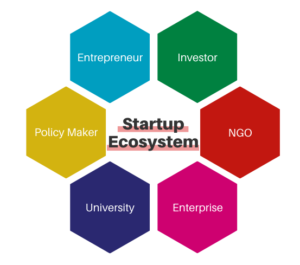
“a mechanism in which a diverse range of people and organizations that support startups are in place and operate in an interconnected way, continuously creating an environment where startups are launched one after another and some go on to grow significantly.”
“Diverse people and organizations” refers to entrepreneurs, research institutions, large corporations, investors, incubators, and others. In many cases, the term “startup ecosystem” is used in the context of evaluating an innovation environment within a specific region.
Key Points
- Startup ecosystems exist at the city and regional level.
Each ecosystem has different strengths—for example, Silicon Valley as a hub for IT and London with strong expertise in finance. - How startup ecosystems are evaluated.
Their maturity is assessed using indicators such as startup investment volume, the number of support organizations, and startup growth rates. - Limited information sharing across ecosystems leads to missed opportunities.
Even with widespread internet access, in-person networking remains highly valued in the startup world, which often limits cross-border collaboration and information exchange across regions and countries.
Challenges / Opportunities in Startup Ecosystems
Challenge: Lost business opportunities due to “information asymmetry”
Potential market needs and the structure of local “ecosystems” vary widely from one region to another. If you select target countries or partners for collaboration without understanding these differences, you risk failing to fully leverage your true potential.
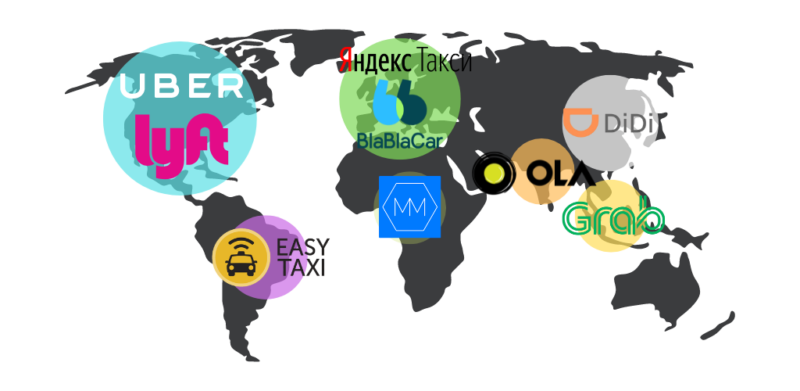
Opportunity: Tracking business reproducibility across markets
As seen in the “time-machine management” approach, advanced business models and ecosystem-building methods can often be replicated in other markets when adapted to local conditions.
Understanding and capturing this reproducibility is our company’s greatest strength.
RouteX’s Information Sharing

RouteX Insights
We share the latest trends in global startup ecosystems on our Insights page, based on proprietary information we have independently collected and accumulated through our worldwide network.

GSER2022 by Startup Genome
We partnered with Startup Genome, a leading startup ecosystem research organization, to release the Japanese edition of its annual report. To contribute as a voice in shaping and systematizing ecosystem-building know-how in Japan, we continue to build our knowledge base and share insights externally.
At RouteX, we provide consultation to governments, local authorities, universities, and other public institutions on building startup ecosystems.
Please submit your inquiry and the details of your needs via the form below.